
Inventory Audit: Procedures, Checklist & Optimization Tips
An inventory audit is one of those behind-the-scenes tasks that rarely feels urgent, until the numbers in your system stop matching what's actually on the shelf. For growing e-commerce brands, that gap can quietly drain profit, trigger stockouts, and throw off every purchasing decision that follows.
The good news is that a well-run audit is completely learnable. This guide breaks down what an inventory audit is, the core procedures auditors rely on, a practical checklist you can follow, and optimization tips to make the whole process faster and far less painful.
TL;DR
- Match records to reality. An inventory audit confirms that your recorded stock matches the physical inventory on hand.
- Core procedures like physical counts, cycle counting, ABC analysis, cut-off analysis, and reconciliation do most of the heavy lifting.
- A simple checklist (prepare, count, reconcile, document, act) keeps every audit consistent and accurate.
- Audit annually at minimum, and support it with ongoing cycle counts throughout the year.
- Lean on technology (and, when it makes sense, a 3PL partner) to turn auditing from a dreaded chore into a routine safeguard.
What Is An Inventory Audit?
An inventory audit is the process of cross-checking your financial and inventory records against the physical stock you actually hold. Sometimes called a stock audit, it's a form of auditing that confirms not just the quantity of goods on hand, but also their condition and value, so the numbers on your balance sheet fairly represent reality.
At its simplest, an audit can be a straightforward physical count matched to your accounting records. In practice, it usually blends several techniques to catch errors, deter theft, and surface the root causes of inventory shrinkage, the gap between what your system says you have and what's really on the shelf.
An audit isn't only about counting. It also verifies that stock is valued correctly and recorded in the right accounting period, which is why cut-off timing (more on that below) matters so much.

Why Inventory Audits Matter
Inventory is often one of the largest assets on a business's books. So, getting it right matters for financing, taxes, and everyday decisions alike.
Regular audits help you spot slow-moving or dead stock, optimize your assortment, reveal losses from theft or damage, and expose weak points in your warehouse and logistics workflows. Choosing the right inventory valuation method and keeping records clean both depend on audits that actually reflect what's in the building.
Industry-wide, shrink is a serious drag on margins. The National Retail Federation pegged average retail shrink at roughly 1.6% of sales, about $112 billion, in its most recent security survey. Catching those losses early, before they compound over a full year, is the entire point of a disciplined audit program.
The 4 Types Of Inventory (And Why They Complicate Audits)
Before you count anything, it helps to know exactly what you're counting. Most product businesses track four main types of inventory:
- Raw materials: inputs waiting to be turned into finished products.
- Work-in-progress (WIP): partially completed goods still moving through production.
- Finished goods: completed products ready to sell and ship.
- MRO: maintenance, repair, and operations supplies that keep the business running but never reach the customer.
Each type is valued and tracked differently, which is exactly why audits get more complex as a catalog grows. A warehouse holding all four needs clear procedures so nothing slips through the cracks between categories.
9 Core Inventory Audit Procedures
There's no single "right" way to run an audit. Auditors mix and match inventory audit procedures based on the size of the business, its industry, and the level of assurance required. These are the most common ones to know:
- Physical inventory count: This is the foundation. Count every item and match it to recorded quantities.
- Cycle counting: Count a rotating subset of items on a schedule instead of shutting down for a full count.
- ABC analysis: Group stock by value and volume so high-value "A" items get counted most often.
- Cut-off analysis: Pause receiving and shipping during the count so transactions land in the correct financial period.
- Analytical procedures: Compare inventory records against key performance metrics such as inventory turnover, gross margin, and days inventory on hand to flag unusual trends, valuation issues, or possible stock discrepancies.
- Freight cost analysis: Confirm that freight-in and landed costs are captured in inventory value, so SKU costs, margins, carrying costs, and reorder decisions reflect the true cost of stock.
- Finished goods and overhead analysis: Verify that material, labor, and indirect costs are allocated correctly (for manufacturers).
- Matching: Tie shipped units back to sales orders, invoices, inventory records, and COGS so the warehouse activity matches the financial records.
- Reconciliation: Trace every discrepancy back to its source, correct the inventory record, and document what changed so the same issue does not keep repeating.
Want To Turn Your Inventory Accuracy Into An Advantage?
The Fulfillment Lab can keep the gap between your records and your shelves as close to zero as possible. You can focus on growing your brand!
Contact Us Today
Your Inventory Audit Checklist
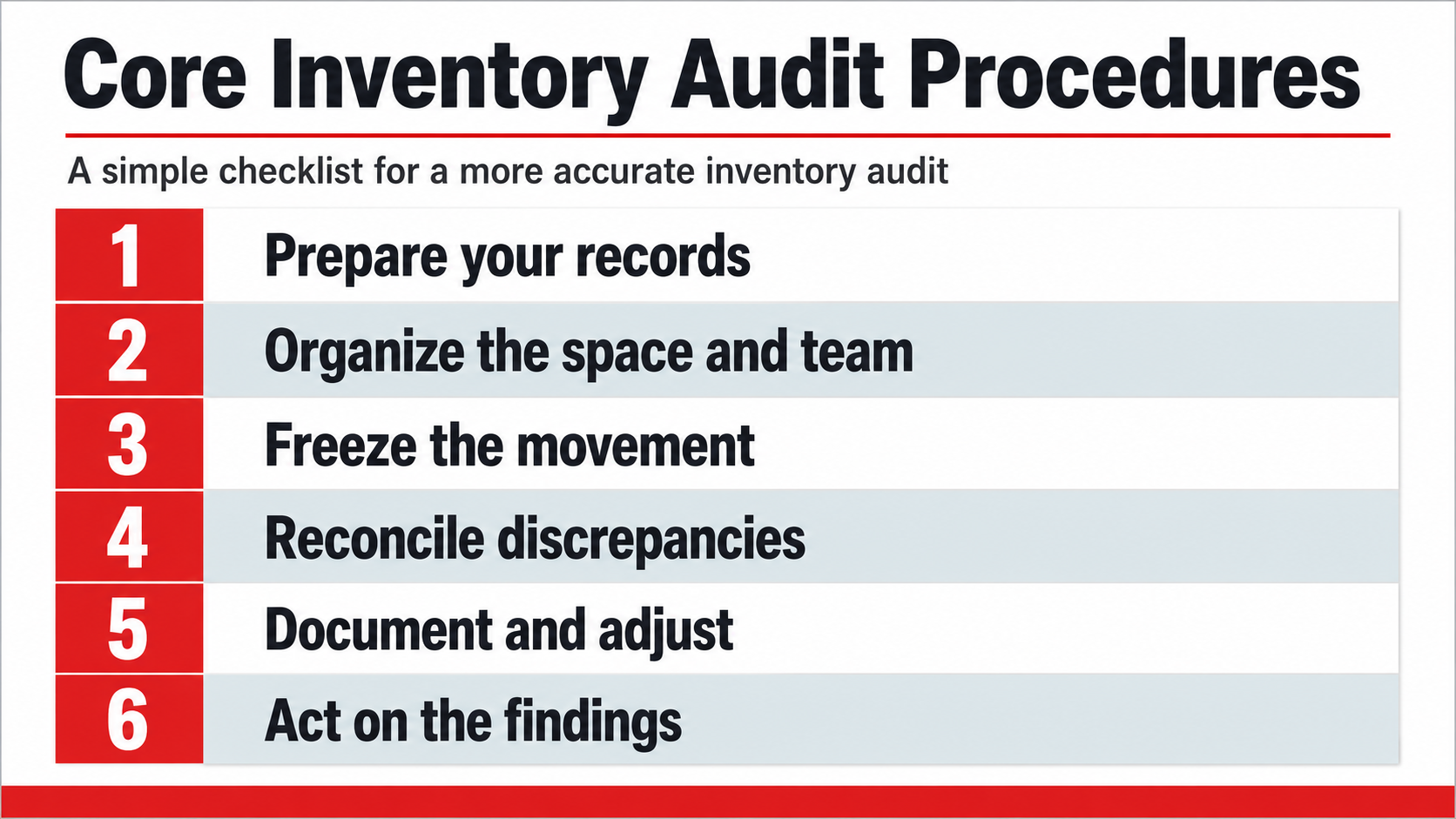
A repeatable inventory audit checklist keeps every count consistent, no matter who runs it. Work through these steps in order:
- Prepare your records: Reconcile recent receipts, transfers, and returns so your system reflects the latest activity before counting begins.
- Organize the space and team: Map the warehouse, assign clear zones, and define exactly who counts what.
- Freeze the movement: Halt receiving and shipping (or clearly flag in-transit items) so nothing gets double-counted.
- Count and record: Work section by section, ideally using barcode scanners to cut down on manual-entry errors.
- Reconcile discrepancies: Compare physical counts to recorded levels and investigate any variance beyond your tolerance.
- Document and adjust: Update inventory records and tag each adjustment with a reason: theft, damage, or error.
- Act on the findings: Fix the process that caused the variance, not just the number on the screen.
💡 Tip: Tag every adjustment with a reason code. Over a few cycles, those codes reveal exactly where your losses come from: a specific shelf, shift, SKU, or supplier.
How Often Should You Audit Your Inventory?
For most businesses, the baseline is a full physical count at least once a year, usually tied to financial reporting and tax season. Companies that hold inventory generally need to count it annually, and for public companies, an independent, external audit of material inventory is required as part of the yearly financial-statement audit; observing physical inventory counts is treated as a generally accepted auditing procedure.
But once a year usually isn't enough to keep records honest. Layering in cycle counts (monthly, weekly, or even daily for your highest-value SKUs) catches errors while they're still small and avoids the operations-halting shutdown that a full count requires. High-turnover e-commerce catalogs benefit the most from frequent, targeted counts.
⚡ In short: audit fully at least once a year for compliance, and cycle count continuously for accuracy.
Optimization Tips For Faster, More Accurate Audits
A few habits separate a painful annual scramble from a smooth, routine audit. These are the small changes that make the biggest difference to your inventory management:
- Scan, don't tally. Barcode or RFID scanning slashes manual-entry errors and speeds up counts dramatically.
- Let software do the reconciling. A modern warehouse management system flags variances automatically and keeps a live count as orders move.
- Prioritize with ABC. Spend your counting time where the money is, not evenly across every SKU.
- Respect the cut-off. Freeze movement during counts so timing errors don't masquerade as shrinkage.
- Chase root causes. Treat every recurring variance as a process problem to fix, not just a number to adjust.
- Consider outsourcing to a 3PL. A 3PL partner with real-time tracking can shoulder the counting burden entirely.
For context, external theft has become the leading driver of shrink in recent years, with shoplifting and organized retail crime rising sharply. A quick example: if your system shows $200,000 of stock but a physical count turns up only $196,000, that's $4,000 of shrinkage; a 2% rate that's worth investigating before it grows.
Turn Inventory Accuracy Into A Growth Advantage
Accurate inventory is the foundation for smart purchasing, reliable e-commerce fulfillment, and happy repeat customers. That's a lot to manage in-house, especially as your order volume climbs.
The Fulfillment Lab handles it for you. We can keep the gap between your records and your shelves as close to zero as possible, and you can focus on growing your brand.
Inventory Audit FAQs
What Is An Audit Of Inventory?
An audit of inventory is the process of verifying that a company's recorded stock matches its actual physical inventory. It confirms the quantity, condition, and value of goods so financial statements accurately reflect what the business truly holds.
How Often Should Inventory Be Audited?
Most businesses run a full physical inventory count at least once a year for tax and financial reporting. Many supplement this with monthly or weekly cycle counts, especially for high-value items to keep records accurate all year round.
What Are The 4 Types Of Inventory?
The four main types are raw materials, work-in-progress (WIP), finished goods, and MRO (maintenance, repair, and operations) supplies. Each moves through the business differently and is valued separately, which shapes how an audit is planned and carried out.
What Is The Role Of An Inventory Auditor?
An inventory auditor verifies that physical stock matches recorded quantities and values. They observe counts, perform independent test counts, review documentation, investigate discrepancies, and confirm inventory is fairly stated, assuring that a company's records can be trusted.
How Is An Inventory Audit Different From A Cycle Count?
An inventory audit is the broad process of verifying stock accuracy; a cycle count is one method used within it. Cycle counts check small subsets of items regularly, while a full audit reviews everything, typically once or twice a year.