
SKU Rationalization: How To Optimize Your Assortment For Profit
SKU rationalization is the discipline of reviewing every product in your catalog and deciding, with real data, what to keep, what to fix, and what to cut. For growing e-commerce brands, it's one of the fastest ways to protect margins without touching the top line.
And the pressure to do it has never been higher: e-commerce now accounts for 16.9% of total U.S. retail sales, which means more competitors, more choice for shoppers, and more ways for a bloated catalog to quietly drain your profit. The upside is that trimming the right products almost always leaves a business leaner, healthier, and easier to scale.
This guide covers what the term means, why oversized assortments hurt, the metrics that actually matter, and a step-by-step process you can put to work this quarter.
TL;DR
- Rationalization removes underperformers so your winners get the space and capital they deserve.
- More isn't better: an oversized lineup adds cost, complexity, and risk faster than it adds sales.
- Judge sales, stock, and profit together; never revenue alone.
- Decisions built on shaky cost numbers do more harm than good.
- The right fulfillment partner turns SKU rationalization analysis into faster turnover and lower costs.
What Is SKU Rationalization?
SKU rationalization is the strategic process of analyzing each item in your product portfolio and using performance data to decide whether to retain it, improve it, or remove it. The goal isn't simply to shrink your catalog; it's to engineer an assortment where every product earns its place by driving sales, satisfying customers, or supporting the broader business. Done well, it lowers carrying costs, frees up warehouse space, simplifies operations, and concentrates demand on the products people actually want.
What Does SKU Mean?
A SKU, or stock-keeping unit, is the unique alphanumeric code a business assigns to a single, distinct product variant. Each combination of attributes (size, color, flavor, or packaging) gets its own SKU, which lets you track sales, manage stock, and measure profitability at the most granular level.
What Does It Mean To Rationalize A SKU?
To rationalize something is to justify it with sound reasoning. Applied to your catalog, that means asking of every product: is this still profitable, still in demand, and still worth the space and capital it consumes? If the answer is no, the item is a candidate for change or removal.
Why SKU Proliferation Quietly Erodes Profit
Most catalogs don't balloon on purpose. They grow one "yes" at a time. A new flavor here, a customer-requested variant there...until you're managing hundreds of items, many of which barely move.
This is SKU proliferation, and its costs are easy to underestimate because they hide across the business: excess inventory, higher storage and handling fees, harder forecasting, slow-moving stock that ties up cash, and product cannibalization where near-identical items split the same demand.
Wider assortments feel like a safety net, but they more often act as a sieve. Every extra item is another thing to store, count, pick, replenish, and write off when it expires or falls out of style. A leaner lineup concentrates customer demand, improves the availability of your winners, and gives your team fewer fires to fight.
Measure What Matters: Sales, Stock & Profit
The biggest mistake in any SKU analysis is judging products on sales volume alone. A best-seller can lose money if it's expensive to store and ship, while a modest performer can be a quiet profit engine if it costs almost nothing to fulfill. To see the truth, weigh three things together: the sales a product drives, the stock it requires, and the profit it ultimately delivers.
That fuller picture is sometimes called direct product profitability:
The total revenue minus the complete cost of getting an item into a customer's hands, including warehousing, handling, transportation, and labor at every step.
Pair it with profit margin, inventory turnover, gross margin return on investment (GMROI), and sell-through rate, and you can rank your catalog with confidence.
The SKU Rationalization Process, Step-By-Step
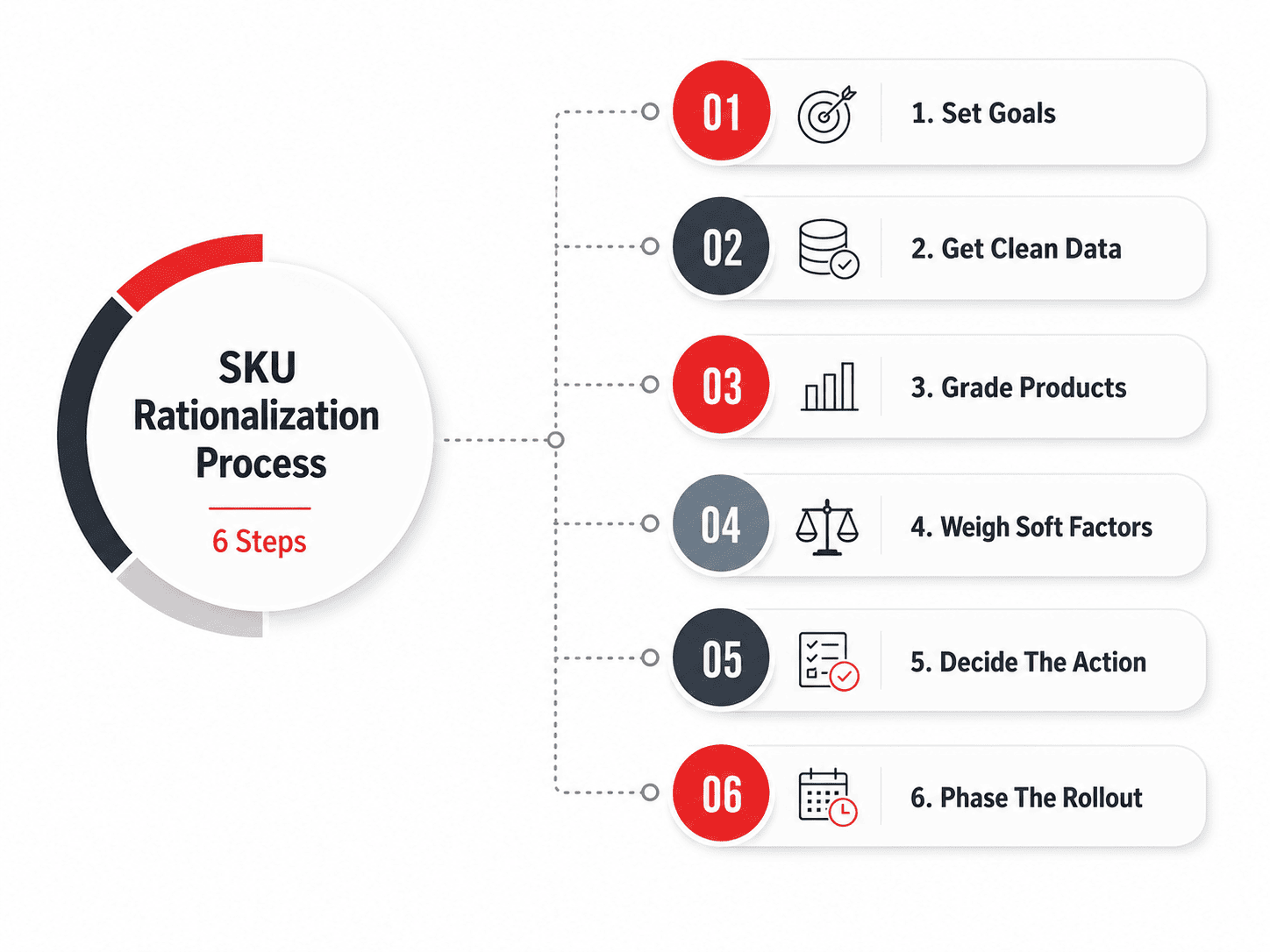
A reliable SKU rationalization process is systematic and data-driven. The specifics vary by industry, but the path looks much the same for most e-commerce brands:
- Set goals. Define what success looks like: lower carrying costs, higher turnover, or improved GMROI, so you can measure progress against real targets.
- Get clean data. Rationalization fails when decisions rest on inaccurate costing, the classic "garbage in, garbage out" trap. Capture true landed cost per item: materials, labor, inbound freight, tariffs, and overhead. Break it down by SKU, product line, and category.
- Grade products. Sort items into tiers using your chosen metrics. The Pareto Principle (the 80/20 rule) is a useful lens: in many catalogs, roughly 20% of products generate around 80% of sales, so protect and feed that vital few.
- Weigh soft factors. Some products earn their keep for reasons a spreadsheet won't show: a loss leader that introduces new customers, a hero item that anchors the brand, or a product whose removal would disrupt supply. Flag these before cutting.
- Decide the action. With grades and context in hand, assign each item to keep, optimize, or discontinue (see the framework below).
- Phase the rollout. Implement changes in stages rather than all at once, watch your KPIs closely, and revisit the exercise at least twice a year as demand and trends shift.
📌 Note: Don't rush new products onto the chopping block. A recent launch needs time to find its audience before its numbers mean anything.
The Data You Need Before Starting SKU Rationalization
- SKU-level sales volume & revenue
- Gross margin and contribution margin
- Inventory on hand
- Inventory turnover
- Sell-through rate
- Storage cost
- Pick, pack, and handling cost
- Return rate
- Shipping cost by SKU
- Stockout and backorder history
- Channel performance
- Seasonality
- Customer reviews and return reasons
The Keep-Optimize-Discontinue Framework
Once products are graded, most decisions fall cleanly into three buckets:
|
Decision |
When It Applies |
What You Do |
|---|---|---|
|
Keep |
Strong performer aligned with goals and demand |
Protect inventory, prioritize space, feed marketing |
|
Optimize |
Underperforming but salvageable |
Adjust price, repackage, bundle with winners, renegotiate supply |
|
Discontinue |
Weak across every metric, no strategic value |
Phase out, clear remaining stock, reallocate resources |
What Is An Example Of SKU Rationalization?
Picture a cosmetics brand selling one lipstick in twelve shades. The data shows three shades drive most of the revenue, five sell steadily, and four barely move yet still consume space, tie up cash, and complicate every reorder. Before cutting the four laggards, the team estimates demand transference: where those sales would go if the shades disappeared.
Because each slow shade has a near-identical neighbor, most buyers would simply pick an adjacent color. The brand discontinues the four, redirects that capital into proven winners, and protects margin without losing customers. That's SKU rationalization in a nutshell: fewer products, healthier business.
SKU Optimization Best Practices (And Mistakes To Avoid)
SKU optimization is an ongoing habit, not a one-time purge. A few principles keep your SKU strategy sharp:
- Make it cross-functional; sales, marketing, operations, and finance each see costs and demand the others miss.
- Listen to customers, not just spreadsheets; reviews explain why a product underperforms and whether it can be fixed.
- Stay seasonal and dynamic, so you refresh the assortment proactively as trends move.
- Lean on technology to surface patterns no manual review will catch.
SKU Rationalization By Product Type
|
Product Category |
Common SKU Issue |
Rationalization Opportunity |
|
Too many shades, scents, or bundles |
Keep hero variants, bundle slow movers |
|
|
Too many bottle sizes or formulas |
Focus on high-repeat purchase SKUs |
|
|
Size and color fragmentation |
Cut weak variants, protect core sellers |
|
|
Seasonal or novelty items pile up |
Review sell-through and reorder behavior |
|
|
Too many components create complexity |
Standardize kit items and reduce prep time |
|
|
Similar SKUs compete with each other |
Consolidate redundant variants |
Most Common Mistakes
- Cutting on sales volume alone,
- Acting on dirty cost data,
- Removing products without modeling where demand will go,
- Treating rationalization as a one-off project rather than a recurring discipline.
💡 Tip: Slow movers aren't always losers. Before discontinuing, see whether bundling them with a best-seller can lift sell-through.
Do You Want To Right-Size Your Assortment?
The Fulfillment Lab brings real-time, transparent reporting on every SKU, U.S.-based support, and strategically located fulfillment centers.
Contact Us Today
How The Right Fulfillment Partner Powers Smart SKU Decisions
Analysis is only half the battle. Εxecution is where leaner assortments pay off. Real-time visibility from purpose-built warehouse management software gives you the accurate, SKU-level data good decisions depend on.
From there, the right 3PL partner helps you act by bundling slow movers with proven winners to lift sell-through. Also, reverse logistics handles returns and clearance of discontinued items responsibly.
Turn Your Catalog Into A Lean, Profit-Focused Assortment
SKU rationalization rewards brands that pair clean data with disciplined action. The Fulfillment Lab brings both: real-time, transparent reporting on every SKU, U.S.-based support that actually picks up the phone, and strategically located fulfillment centers that turn your decisions into faster turnover, lower holding costs, and an operation built to scale.
If your catalog has outgrown its profitability, there's no better time to right-size it.
Let's right-size your assortment together!
Frequently Asked Questions
What Does SKU Mean?
A SKU (stock-keeping unit) is a unique alphanumeric code assigned to a single product variant. It captures attributes like size, color, or packaging, letting businesses track sales, manage inventory, and measure profitability for each distinct item.
What Is An Example Of SKU Rationalization?
A supplement brand selling one formula in six bottle sizes finds two sizes drive nearly all sales. It discontinues the three slowest, keeps the proven sizes, and reinvests the freed-up capital and warehouse space into higher-demand products.
What Is A SKU Strategy?
A SKU strategy is your ongoing plan for how products enter, evolve within, and exit your assortment. It governs how you grade performance, set inventory levels, and balance variety against the cost and complexity each new item adds.
How Often Should You Run SKU Rationalization?
Most brands should review their assortment at least every six months. Waiting longer lets dead stock accumulate and misses optimization opportunities, while frequent check-ins keep your catalog aligned with shifting demand and seasonal trends.
What Is SKU Proliferation?
SKU proliferation is the gradual, often unplanned growth of your product catalog as variants and one-off additions pile up. Left unchecked, it inflates storage and handling costs, complicates forecasting, and splits demand across near-identical items.