
Generative AI In Ecommerce: Use Cases Across The Buyer Journey
Generative AI in ecommerce has moved from novelty to being a necessity in under two years. Where earlier tools quietly crunched data in the background, today's models write product copy, answer shopper questions, forecast demand, and even complete purchases on a customer's behalf.
This guide maps the most practical generative AI use cases in ecommerce to each stage of that journey, so you can see exactly where automation lives up to its promise. And since the journey doesn't end at checkout, we'll spend extra time on the post-purchase and fulfillment layer, where speed and accuracy quietly decide whether a first order becomes a repeat customer.
TL;DR
- Generative AI spans the whole journey, from awareness and discovery to purchase, delivery, and repeat orders.
- Content, search, and recommendations dominate the front end, helping shoppers find and trust products faster.
- AI agents are the frontier, with assistants that browse, compare, and buy for shoppers.
- AI protects margins by sharpening demand forecasts, optimizing inventory, and making fulfillment faster, leaner, and more accurate.
- Human oversight still matters; pair AI speed with brand judgment and reliable logistics.
What Is Generative AI In Ecommerce?
Generative AI ecommerce refers to the use of models that create new content, be it text, images, audio, and even code, to power online retail experiences. Unlike traditional automation that follows fixed rules, these systems are trained on large datasets and can generate original text, images, and video in response to a prompt.
Most tools reshaping online retail draw on four main model families: generative adversarial networks (GANs), variational autoencoders (VAEs), diffusion models, and transformers. Transformers power the large language models behind chatbots, for example, while diffusion models generate the product imagery and lifestyle scenes brands once paid studios to shoot.
➡️ In practice, generative AI is the layer that turns raw customer data into personalized, on-demand experiences to generate a product description, a chat reply, or a demand forecast. All of these are produced in seconds now rather than days.
Adoption is accelerating fast. McKinsey reports that 65% of organizations now use generative AI regularly, nearly double the share from ten months earlier, and estimates the technology could unlock $240 billion to $390 billion in value for retailers alone. The dedicated generative AI in retail market is expanding at a double-digit annual clip as brands race to keep pace.
AI For Awareness & Discovery: Getting Found And Getting Noticed
The buyer journey starts long before checkout, and this is where content and search now decide who wins attention.
AI content generation has become the workhorse of the discovery stage. Tools can draft product descriptions, category pages, ad copy, and blog content in a fraction of the time a team would need, freeing writers to edit and elevate rather than start from scratch. The catch is quality control: AI copy still needs human review to keep it accurate, on-brand, and genuinely useful.
Search itself has changed shape. Natural language processing lets on-site search engines interpret messy, conversational queries and surface the right product by style, material, or color instead of matching keywords. Off-site, AI-generated answer boxes now sit above traditional results, which means brands increasingly need answer engine optimization (AEO) and generative engine optimization (GEO) alongside classic SEO to stay visible.
Visual search closes the loop for shoppers who can show what they want but can't describe it. A customer uploads a photo, and the model returns visually similar items; a discovery experience that's especially powerful for fashion, home, and beauty brands.
AI For Consideration: Guiding The Shopper Toward A Decision
Once a shopper is browsing, generative AI could work to reduce hesitation and friction.
Product recommendation engines analyze browsing history, past purchases, and cart contents to suggest relevant items, powering the cross-sells and upsells that lift average order value. Done well, recommendations feel less like advertising and more like a helpful nudge.
Conversational commerce is the most visible of the Gen AI use cases in ecommerce. AI chatbots handle questions around the clock, recommend products, and resolve issues without a human agent. Modern AI automations go further, surfacing reviews, comparing specs, and guiding a shopper from curiosity to confidence. Alexa for Shopping, a generative shopping assistant built into the Amazon app, is a mainstream example of where consideration-stage AI is heading.
📌 Note: A chatbot only helps if it's honest. Assistants that oversell or hallucinate product details erode trust faster than no chatbot at all. Accuracy is the whole point.
Want To Turn AI-Driven Demand Into Orders That Ship On Time?
The Fulfillment Lab offers e-commerce fulfillment services backed by real-time insights, dedicated US-based support, and international shipping.
Contact Us Today
AI For Purchase & Conversion: Closing The Sale
At the decision point, small improvements in relevance and trust compound into real revenue.
Hyper-personalization tailors the storefront, messaging, and offers to the individual rather than a broad segment. McKinsey finds personalization typically drives a 5–15% revenue lift and meaningfully improves marketing efficiency; a direct payoff for getting the right product in front of the right person at the right moment. TFL's own guide to ecommerce personalization breaks down how that plays out across the funnel.
More decision-stage AI applications could be:
- Dynamic pricing models that adjust prices in response to demand, competitor activity, and customer behavior, helping brands protect margin during peaks and stay competitive in slow periods.
- Fraud-prevention models that scan transaction data in real time, flagging mismatched billing and shipping details or unusual purchase patterns before they become chargebacks.
AI For Post-Purchase & Fulfillment: Where Loyalty Is Actually Earned
Here's the stage most "AI in ecommerce" articles rush past – and where the customer relationship is truly won. A brilliant storefront means nothing if the order ships late, arrives wrong, or runs out of stock. This is where AI in ecommerce quietly protects revenue after the sale.
Demand forecasting is the clearest win. By analyzing historical sales and real-time signals, models anticipate seasonal spikes and steady demand alike, so brands reorder before they stock out and avoid tying up cash in overstock. That forecast feeds directly into smarter inventory management and a healthier global order fulfillment strategy.
The predictions only pay off if the physical operation can execute. Accurate forecasts need to connect to real warehouse capacity, disciplined pick and pack workflows, and software that keeps stock and orders in sync. The Fulfillment Lab's order fulfillment software pairs real-time visibility with forecasting tools so the data-driven plan and the shipping dock stay aligned.
Generative AI also personalizes the post-purchase moment. Insights about who's behind each order let brands tailor what goes in the box:
- a first-purchase welcome card,
- a loyalty-tier sample,
- an insert matched to the buyer,
- other marketing materials with each order.
Kitting and assembly turns a plain shipment into a branded unboxing experience.
Generative AI Use Cases Mapped To The Buyer’s Journey
|
Buyer’s Journey Stage |
Generative AI Use Case |
Business Payoff |
|---|---|---|
|
Awareness & Discovery |
Content generation, AI/visual search, GEO |
More qualified traffic, faster discovery |
|
Consideration |
Recommendations, chatbots, shopping assistants |
Higher engagement, lower bounce |
|
Purchase |
Personalization, dynamic pricing, fraud checks |
Better conversion, protected margin |
|
Post-Purchase |
Forecasting, inventory, returns, personalized packing |
Fewer stockouts, stronger loyalty |
|
Across All Stages |
AI agents that browse, decide, and buy |
New, automated path to purchase |
The Rise Of AI Agents: The Ecommerce Future
If today's tools assist the shopper, tomorrow's will act on their behalf. AI agents for ecommerce are autonomous systems that browse catalogs, compare options, and complete purchases with minimal human input, reshaping the funnel from a series of clicks into a single delegated task.
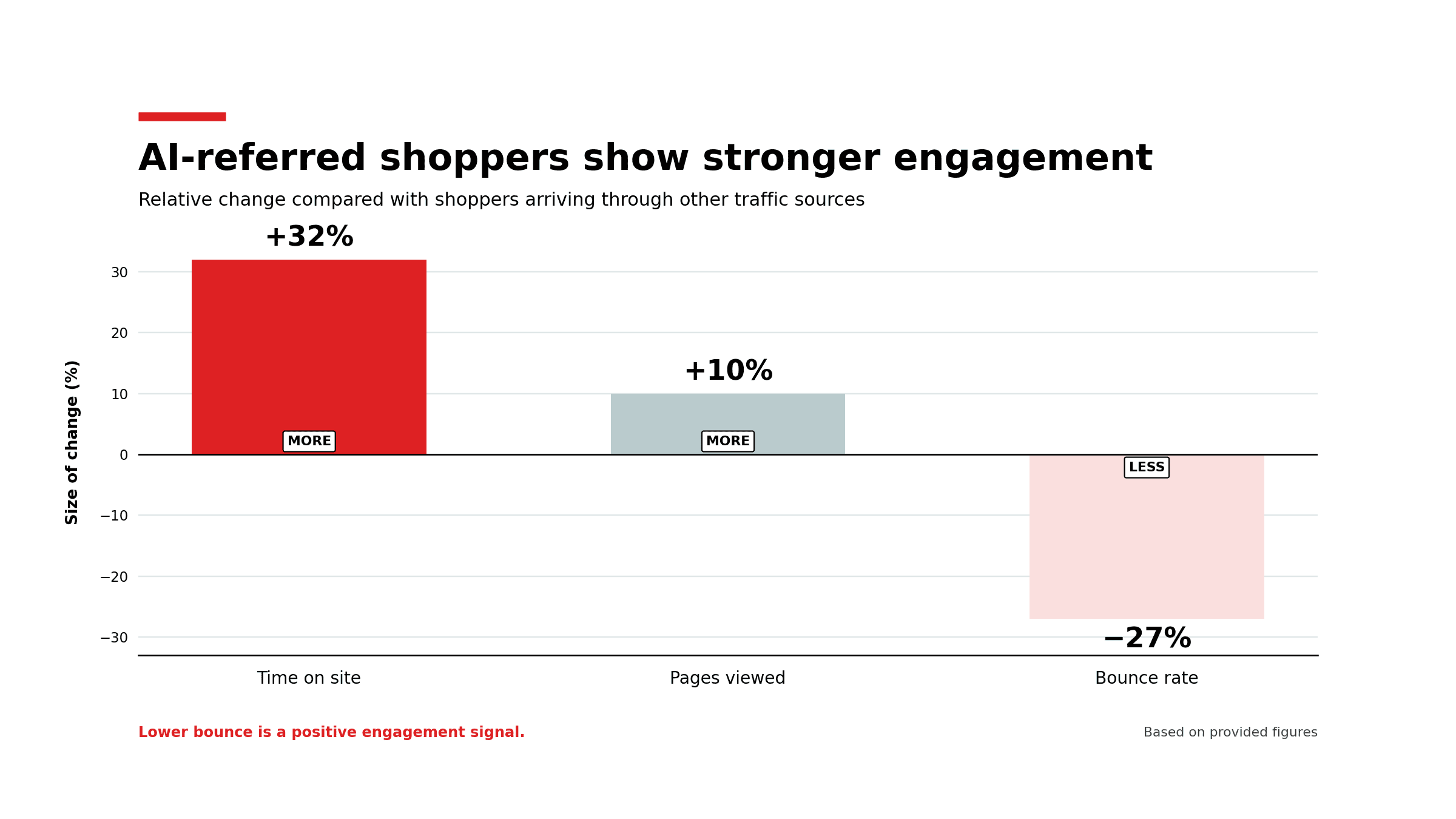
The early signals are striking. Boston Consulting Group reports that shoppers who begin their journey through AI agents and chatbots spend 32% more time on site, browse 10% more pages, and bounce 27% less often. This is evidence that agent-led discovery is stickier, not shallower. As ecommerce AI agents mature, an AI agent for ecommerce may handle reordering household staples or sourcing a specific item across multiple stores without the shopper ever visiting a homepage.
That shift changes how brands compete. To be selected by an agent, your product data, schema, and content have to be clean and machine-readable. The future of ecommerce rewards brands whose catalogs and logistics are structured, accurate, and ready for both human and machine buyers. And it isn't slowing down.
US e-commerce already accounts for roughly 16-17% of total retail sales. That percentage is likely to climb as consumers begin adopting AI agents at scale.
Turn AI-Driven Demand Into Orders That Ship On Time
Generative AI can win the click, personalize the offer, and even place the order, but the promise only holds if fulfillment delivers. That's the layer The Fulfillment Lab was built for: ecommerce fulfillment services backed by real-time insights, dedicated US-based support, and international shipping that handles customs and duties without friction.
You bring the customer-facing AI toolset; we make sure every order behind it arrives accurately and on time.
Ready to connect smart demand to reliable delivery?
Frequently Asked Questions
How Is AI Being Used In Ecommerce?
AI powers the full journey: content and search at discovery, recommendations and chatbots during consideration, personalization and fraud checks at purchase, and forecasting, inventory, and returns after the sale.
What Are The 4 Types Of Ecommerce?
The four core e-commerce models are business-to-consumer (B2C), business-to-business (B2B), consumer-to-consumer (C2C), and consumer-to-business (C2B). Each defines who sells to whom.
What Are The Four Types Of Generative AI?
The four widely used generative model families are generative adversarial networks (GANs), variational autoencoders (VAEs), diffusion models, and transformers. Transformers power text tools like chatbots, while diffusion models create the product images and video used in marketing.
What Is The Best AI For Ecommerce?
There's no single "best" tool. The best approach comes down to what you want to achieve. A skincare brand might prioritize a quiz-style chatbot, while a high-SKU seller leans on forecasting AI. Match the tool to your biggest bottleneck first.
What Are AI Agents For Ecommerce?
AI agents are autonomous programs that browse, compare, and buy products with little human input. For merchants, they are a new path to purchase that rewards clean product data, structured content, and fulfillment ready to execute their orders.