
The Reorder Point Formula (And How To Use It To Maximize Sales)
The reorder point formula is one of the simplest tools in inventory management, and one of the most profitable when you use it well. It tells you the exact stock level at which to place your next purchase order: early enough to avoid running out, but not so early that you tie up cash in shelves of product you don't need yet.
For online brands, reorder timing is everything. U.S. e-commerce hit $316.1 billion in the fourth quarter of 2025 (about 16.6% of all retail sales), and that share has climbed steadily for years.
In a market that is competitive, every stockout is a sale handed to someone else. Get your reorder points right, and you keep your best-sellers available, your customers loyal, and your revenue moving in the right direction.
TL;DR
- The reorder point formula for inventory management reads like this: (average daily sales × lead time) + safety stock = the stock level that triggers your next order.
- You need three inputs: sales speed, restock time, and buffer stock.
- The buffer stock is your cushion; the trigger is the level that already includes it.
- EOQ is different: it sets how much to order, while the trigger sets when.
- The payoff: fewer stockouts, less overstock, freed-up cash, and protected sales.
What Is A Reorder Point?
A reorder point (ROP) is the lowest stock level a product should hit before you reorder it. When inventory drops to that number, it's your cue to send a purchase order to your supplier. Soon enough, the new shipment will arrive before you sell out. You'll sometimes see it called the reorder level, or ROL; the terms are interchangeable.
An ROP isn't a single fixed number you set once and forget. It's specific to each product (or SKU) and shifts as your sales velocity, suppliers, and seasons change. A fast-moving lip balm with a two-week supplier lead time will land at a very different level than a niche supplement you restock once a quarter.
💡 Tip: Calculate reorder points per SKU, not across your whole catalog. A blanket number that "feels about right" almost always leaves your top sellers exposed and your slow movers overstocked.
The Reorder Point Formula In Inventory Management
Here's the calculation in its most usable form:
➡️ Reorder point = (average daily sales × lead time in days) + safety stock
That single line captures three realities of running a product business: how quickly an item leaves your shelves, how long it takes to replace, and how much of a buffer you want against the unexpected. The first two multiplied together are your lead time demand; the units you expect to sell while you wait for a restock. Add safety stock, and you've got the trigger that keeps you covered. This is the same logic baked into nearly every modern warehouse management system.
How To Calculate Reorder Point: A Step-By-Step Walkthrough
Knowing how to calculate the reorder point comes down to nailing three inputs. Let's break each one down, then run a full example.
1. Average Daily Sales
Divide the total units sold over a period by the number of days in that period. If you sold 1,200 units of a face serum over the last 30 days, your average daily sales are 40 units. Pull at least three to six months of data where you can. The longer the window, the more your numbers smooth out seasonal noise.
2. Lead Time
Lead time is the number of days between placing a purchase order and having that stock ready to sell. Track it from your past orders and take an average. If you're working with a new supplier or shipping across borders, build in a little extra cushion until their reliability is proven. Reorder points matter most when supplier timelines are hard to predict, and stockouts are expensive.
3. Safety Stock
Safety stock is the buffer you hold for the "just in case", like a demand spike, a delayed shipment, or a product lost in transit. A common way to size it:
Safety stock = (max daily sales × max lead time) − (avg daily sales × avg lead time)
It's worth getting this number right, because it's the piece most brands either skip or guess at.
A Worked Reorder Point Calculation Example
Say you run a skincare brand and want to set the reorder point for your hero serum:
|
Input |
Value |
|---|---|
|
Average daily sales |
40 units |
|
Average lead time |
7 days |
|
Maximum daily sales |
60 units |
|
Maximum lead time |
12 days |
|
Reorder Point (Result) |
720 units |
Here's the reorder point calculation step by step:
- Lead time demand = 40 units × 7 days = 280 units
- Safety stock = (60 × 12) − (40 × 7) = 440 units
- Reorder point = 280 + 440 = 720 units
So when your serum inventory drops to 720 units, you place your next order. Even if demand surges to its peak and your supplier takes their longest, you should still have product on the shelf when the restock lands.
💡 Tip: Set reorder points per location, too. If you store inventory in more than one warehouse, each one needs its own number based on the demand and lead time it actually sees.
Safety Stock vs Reorder Point: What's The Difference?
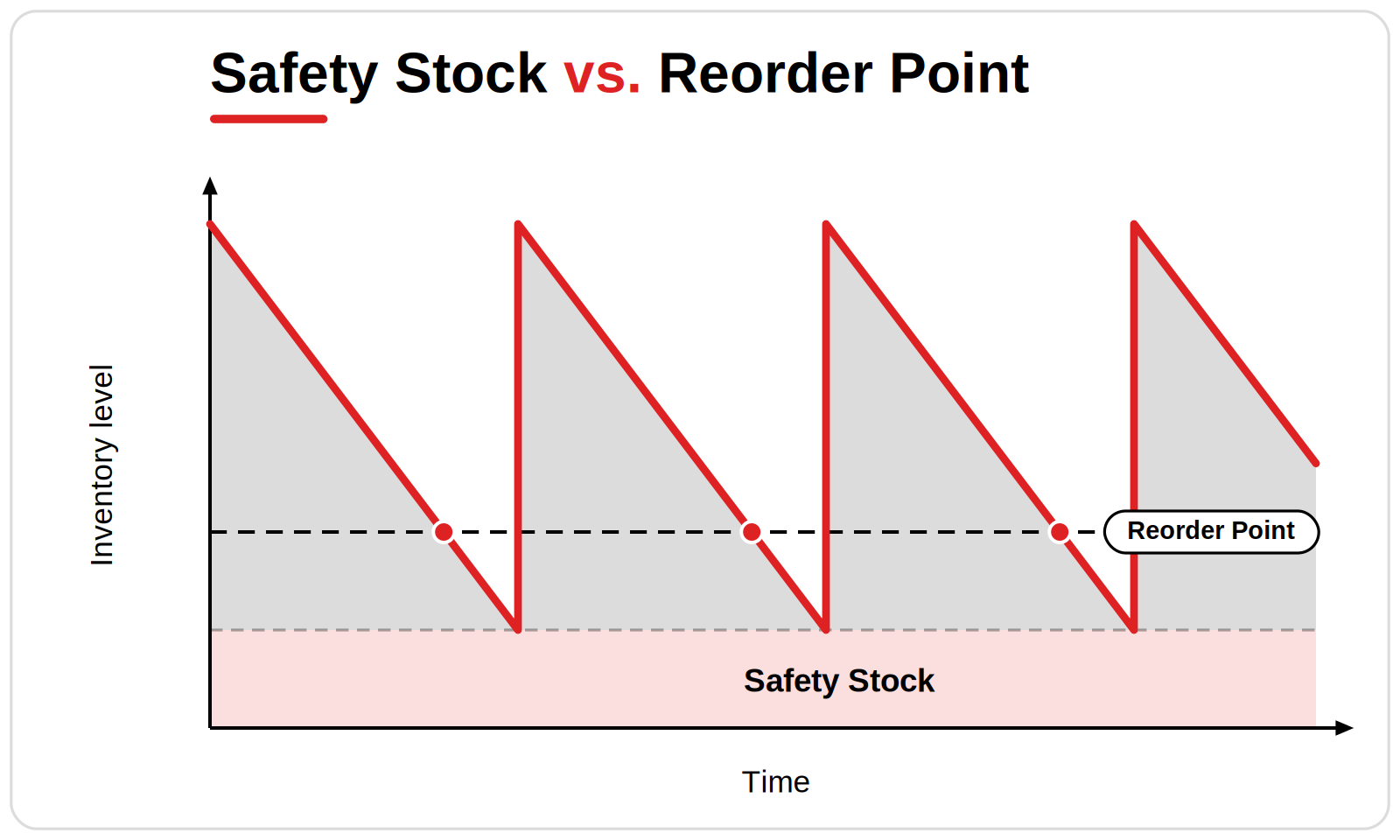
The safety stock vs reorder point comparison confuses a lot of people, because the two are tightly linked but play different roles. The simplest way to keep them straight:
|
Safety Stock |
Reorder Point |
|
|---|---|---|
|
What It Is |
Extra buffer inventory |
A stock-level trigger |
|
Its Job |
Absorbs surprises |
Tells you when to reorder |
|
Relationship |
A component of the trigger |
Includes safety stock in its math |
In short, safety stock is your backup layer, while the reorder point is the trigger that tells you to restock before that backup gets touched.
What Is The EOQ Reorder Point Connection?
Once you know when to reorder, the natural next question is how much to order. That's where Economic Order Quantity comes in.
What Is EOQ And Its Formula?
EOQ (Economic Order Quantity) is the order size that minimizes your combined ordering and holding costs. First developed by Ford W. Harris back in 1913, it's one of the oldest models in inventory management and is still widely used. The formula is:
➡️ EOQ = √(2DS ÷ H)
Where:
- D is the annual demand,
- S is the fixed cost per order,
- H is the cost to hold one unit for a year.
The result is your sweet spot: order in batches that big, and you're not overpaying in shipping and handling from ordering too often, nor bleeding cash on carrying costs from ordering too much.
Are ROL And EOQ The Same?
No. They answer two different questions and shouldn't be confused. The reorder level (ROL, another name for the reorder point) tells you when to place an order. EOQ tells you how much to order once you do. Use them as a pair: your trigger fires the signal, and your EOQ sizes the response.
How To Set Reorder Points In Excel
You don't need fancy software to start. A spreadsheet works fine for a manageable catalog. In Excel or Google Sheets, dedicate columns to average daily sales, lead time, and safety stock, then build a reorder-point column with a simple formula such as =(B2*C2)+D2. Add conditional formatting so a cell turns red the moment on-hand quantity falls to or below that number, and you've got a free, visual low-stock alert.
The catch is upkeep. Spreadsheets don't update themselves, and as your SKU count and order volume climb, manual recalculation becomes a real risk to your accuracy. That's the point where most growing brands move their triggers into an ecommerce inventory management platform, where live sales data and automated alerts do the watching for you.
Do You Want To Turn Your Reorder Point Into Faster, Smarter Shipping?
The Fulfillment Lab pairs real-time inventory visibility with hands-on e-commerce fulfillment services.
Contact Us Today
How Reorder Points Help You Maximize Sales
It's easy to think of reorder points as defensive housekeeping. In reality, they're a growth lever. Here's how a well-tuned trigger directly protects and grows revenue:
- It stops stockouts. An out-of-stock listing pushes a shopper toward a competitor and dents the customer trust you spent money to earn.
- It frees up capital. Reordering at the right moment means you're not parking thousands of dollars in product that sits for months, racking up storage and holding costs.
- It offers predictable replenishment. Steady, data-driven inventory replenishment replaces panic buying and rush-shipping fees with a calm, repeatable rhythm.
- It allows sharper forecasting. Tracking your triggers across the catalog reveals real demand patterns, which feed better purchasing decisions everywhere.
- It protects speed. Keeping the right stock in the right place is what makes fast, reliable delivery possible. And fast delivery is what keeps shoppers coming back.
That last point is where fulfillment strategy meets the math. A perfect reorder point still depends on inventory being positioned close to your customers and moving the moment an order comes in. That's the difference between a number on a spreadsheet and a shipment on a doorstep.
Turn Your Reorder Points Into Faster, Smarter Shipping
A reorder point is only as good as the operation behind it. The Fulfillment Lab pairs real-time inventory visibility with hands-on ecommerce fulfillment services. Once your stock hits its trigger, replenishment, pick and pack, kitting, and fast nationwide shipping all keep moving without you “babysitting a spreadsheet”.
If you're ready to stop guessing at stock levels and start keeping your best-sellers available, we'd love to show you how it works.
Frequently Asked Questions
What Is The Formula For Reorder Point In Excel?
In a spreadsheet, the reorder point formula is =(average daily sales × lead time) + safety stock, for example, =(B2*C2)+D2. Add conditional formatting to flag cells in red when on-hand stock drops to that level.
Are ROL And EOQ The Same?
No. ROL (reorder level, also called the reorder point) tells you when to place an order, based on demand and lead time. EOQ tells you how much to order to minimize total inventory costs. They're complementary, not interchangeable.
Can You Show A Quick Reorder Point Example?
A pet-supplies brand sells 25 units of a chew toy daily, with a 10-day lead time and 100 units of safety stock. Its reorder point is (25 × 10) + 100 = 350 units. They’ll need to reorder when stock hits 350.
How Often Should I Recalculate My Reorder Point?
Review your triggers at least quarterly, and any time you switch suppliers, see lead times shift, or hit a seasonal swing. Reorder points drift as demand and supply change, so stale numbers quietly reintroduce stockout and overstocking risks.
What Is The EOQ Reorder Point?
It's the pairing of two models: the reorder point signals when to order, and EOQ determines the ideal order size at that moment. Used together, they minimize ordering and holding costs while protecting against stockouts.