
Ecommerce Personalization: Examples & Data-Driven Strategies
Ecommerce personalization is no longer a competitive edge reserved for the “Amazons” and “Netflixes” of the world; it's what shoppers expect every time they land on a product page, open an email, or tear into a package. With U.S. shoppers spending $326.7 billion in Q1 of 2026, about 16.9% of all retail sales, the brands that win are the ones that make each of those interactions feel built for one person.
The good news? You don't need an enterprise budget to deliver relevant, tailored experiences. You need the right data, a clear plan, and a willingness to extend personalization beyond the "Add to Cart" button, all the way to the moment your customer opens the box. This guide breaks down what personalization really means, the numbers behind it, and the practical strategies (with real-world examples) you can put to work this quarter.
TL;DR
- Ecommerce personalization tailors the shopping experience to each customer using behavioral, transactional, and zero-party data.
- The data is hard to ignore: personalization can lift revenue 5–15% and cut acquisition costs by up to half, according to McKinsey.
- Seven proven strategies cover product recommendations, personalized search, lifecycle messaging, dynamic content, and the often-ignored post-purchase experience.
- Personalization and customization aren't the same thing; one is brand-driven, the other is customer-controlled.
- Fulfillment is part of personalization too: branded packaging, kitting, and inserts turn a routine delivery into a brand moment.
What Is Ecommerce Personalization?
The simplest definition of personalization in ecommerce is the practice of using customer data to tailor content, product recommendations, search results, offers, and messaging to each individual shopper. Where generic merchandising shows everyone the same storefront, personalization adapts what a visitor sees based on who they are and how they behave.
To personalize is to make something fit a particular individual. In ecommerce, that means:
- a returning customer sees the brands and sizes they prefer,
- a first-time visitor gets a welcome offer,
- a lapsed buyer receives a nudge about the product they left behind.
➡️ In short: personalization is brand-driven relevance powered by data. The system makes smart choices on the shopper's behalf so they spend less time hunting and more time buying.
Personalization vs Customization
It's worth separating the two terms people use interchangeably. Personalization and customization in e-commerce describe different things:
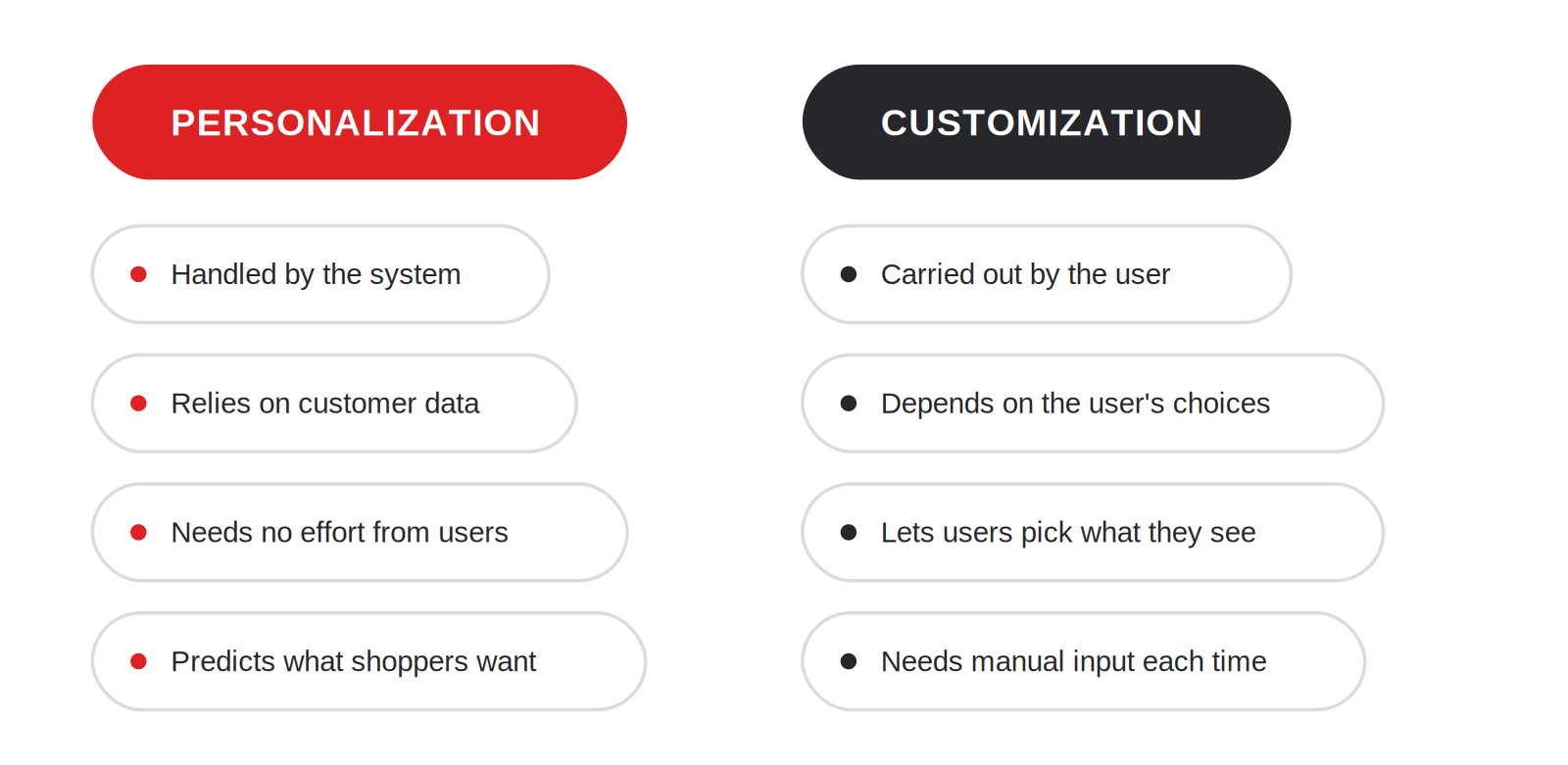
In short:
✔️ E-commerce personalization happens automatically behind the scenes.
✔️ E-commerce customization puts the controls in the customer's hands.
Personalization vs Customization Comparison Table
|
Aspect |
Personalization |
Customization |
|---|---|---|
|
Who's In Control |
The brand (driven by data and AI) |
The customer (manual choices) |
|
How It Works |
Recommends products, adapts content automatically |
Shopper picks colors, builds a bundle, sets preferences |
|
Example |
"Recommended for you" carousel |
Choosing a monogram or dark mode |
|
Data Needed |
Behavioral and purchase history |
Direct, explicit input |
Why Ecommerce Personalization Matters: A Close Look At The Data
This is where data-driven personalization for ecommerce earns its keep.
- McKinsey reports that personalization can lift revenue by 5-15%, reduce customer acquisition costs by as much as 50%, and improve marketing ROI by 10-30%.
- Fast-growing companies pull roughly 40% more of their revenue from personalization than slower-growing peers.
- Gartner found that shoppers who experience active personalization are 2.3 times more likely to confidently complete a critical purchase decision.
- Twilio's research shows 80% of consumers are more likely to buy when engagement is personalized in real time, and 78% of businesses report increased customer spend from their personalization efforts.
Yet only 45% of consumers feel truly understood by the brands they buy from. That last gap is the opportunity. Demand for relevance is sky-high, but most brands still under-deliver. Closing the gap between expectation and execution is where growth lives.
💡 Tip: You don't have to personalize everything at once. Start with your highest-traffic, highest-intent touchpoints (product pages and checkout), then expand.
7 Data-Driven Ecommerce Personalization Strategies
Looking for ecommerce personalization ideas you can actually ship? These seven strategies span the full funnel and work whether you're doing $500K or $50M a year.
Serve Dynamic Product Recommendations
"You might also like" and "Frequently bought together" widgets are the workhorses of personalization. Powered by browsing and purchase history, smart customer recommendations lift average order value and help shoppers discover items they'd otherwise miss.
Personalize On-Site Search
Search visitors convert at far higher rates than browsers, yet most stores still return generic results. Personalized search in e-commerce uses past behavior and intent to surface the right products first; a query for "black running shoes" doesn't bury the shoes under accessories. Investing in ecommerce search personalization is one of the highest-leverage moves you can make.
Map & Trigger The Customer Journey
Effective customer journey personalization means different messaging at different stages: a welcome series for new shoppers, restock reminders for repeat buyers, and win-back offers for the inactive. Mapping the e-commerce customer journey first tells you which triggers matter most.
Use Dynamic Content & Landing Pages
Show a first-time visitor an introductory offer and a returning customer a category they love. Match ad creative to the landing page so the experience feels seamless from click to conversion.
Automate Behavioral Email & SMS
Cart abandonment, browse abandonment, and post-purchase follow-ups recover revenue that would otherwise walk out the door. The key is relevance: reference the exact product the shopper viewed, not a generic blast.
Tailor By Location
You can surface local inventory, regional bestsellers, and local currency. But don’t forget: the strongest location signal is delivery time. Not every city or zone should see the same shipping promise: a shopper near your closest fulfillment center might see "arrives tomorrow," while a more remote zip code sees an honest two- to three-day window.
Show each visitor a location-specific estimated delivery date (ETD) based on the nearest warehouse and the last-mile carrier serving their area, instead of a general promise of "ships in 5–7 days." Accurate, zone-level ETDs are what set expectations correctly and keep shoppers from abandoning at checkout.
Personalize The Post-Purchase Experience
This is the strategy most brands forget. E-commerce product personalization extends past the website into the unboxing: branded packaging, a handwritten-style thank-you insert, a sample sized for that customer's order. It's the one personalized touch your competitors can't screenshot.
Ecommerce Personalization Examples
A few quick ecommerce personalization examples show how these strategies play out in the wild:
- Beauty and skincare: A retailer notices a customer reorders the same serum every three months and sends a "time to restock" email right before they run out. Plus, early access to a seasonal sale on the anti-aging line they always browse.
- Apparel: A returning shopper logs in, and the homepage surfaces their size and preferred fit, while a quiz captures style preferences (zero-party data) to power future recommendations.
- Subscription boxes: Each box is assembled around the subscriber's stated preferences and seasonal themes, with inserts that reflect their tier and tenure.
- Pet supplies: A store promotes "new toys sized for a senior small-breed dog" instead of generic dog food, because the customer told them about their aging dachshund.
The thread connecting all of them: relevance built on data the customer willingly shared or behavior the brand observed in an ethical and lawful way.
Do You Want To Bring Your Brand Into Every Box You Ship?
The Fulfillment Lab helps growing ecommerce businesses turn one-time buyers into loyal customers with personalized packaging and fulfillment experiences.
Contact Us Today
B2B Ecommerce Personalization
Personalization isn't only a consumer game. B2B ecommerce personalization focuses on business context, like industry, company size, contract pricing, and the buying committee, rather than individual taste. A returning B2B buyer should see their negotiated prices, fast reordering of past purchases, and content matched to their use case. Because B2B orders are larger and reorders are frequent, even small gains in relevance compound quickly across an account's lifetime value.
The Fulfillment Side Of Personalization
Here's the part of the conversation that gets skipped: personalization doesn't end at the confirmation page. The package itself is a touchpoint. After investing in a tailored on-site experience, shipping that order in a plain brown box is a missed moment.
At The Fulfillment Lab, this is where the physical experience meets your data. Through custom packaging, branded inserts, and kitting and assembly, each shipment can reflect the customer behind the order, whether that's a first-purchase welcome card, a loyalty-tier upgrade, or a sample chosen to match what they bought.
Behind the scenes, real-time visibility and forecasting tools in our fulfillment software keep inventory and orders in sync, ensuring the right products are always in stock to fulfill those personalized promises.
The same data discipline that powers on-site personalization should power your ecommerce fulfillment, too. Solid warehouse management and accurate forecasting are what will let you avoid the backorders that quietly break a "recommended for you" experience – one of the most common fulfillment challenges growing brands run into.
📌 Personalization depends on data, and shoppers increasingly want control over it. Regulations like the California Consumer Privacy Act (CCPA) give them the right to know what's collected and to opt out. Be transparent about what you gather and why; trust is what keeps customers coming in and the data flowing.
Bring Your Brand Into Every Box You Ship
You can build the most relevant storefront on the planet, but if the delivery experience is generic, the impression you leave is the same. The brands that turn one-time buyers into loyal customers extend personalization across the whole journey, from the first click to the moment the box hits the doorstep.
The Fulfillment Lab helps growing ecommerce businesses do exactly that: faster, more accurate, on-brand ecommerce fulfillment services with the transparency and fulfillment-center technology to back every personalized promise you make.
Ready to make every order feel personal?
Let's Build Your Fulfillment Strategy Together
Frequently Asked Questions
What Is The Best Ecommerce Personalization Software?
There's no single best ecommerce personalization platform; it depends on your needs. On-site personalization, search, email/SMS automation, and customer data platforms each solve different problems. The best ecommerce personalization software is whatever unifies your data and integrates cleanly with your existing stack.
What Are The 5 C's Of Ecommerce?
The 5 C's are commonly framed as the pillars of a strong online experience: Content, Community, Convenience, Conversion, and Customer Care.
What Is The 80/20 Rule In Ecommerce?
The 80/20 rule, or Pareto Principle, holds that roughly 80% of outcomes come from 20% of causes. In ecommerce, about 80% of revenue often comes from 20% of customers, your prime targets for personalization and retention efforts.
Can You Give An Example Of Ecommerce Personalization?
A home-goods store detects a shopper repeatedly viewing dining furniture, then emails a curated "complete your dining room" collection with items matched to their browsing, plus free shipping, turning passive interest into a higher-value order at exactly the right moment.
What's The Difference Between Personalization And Customization?
Personalization is brand-controlled: the system tailors experiences automatically using data and AI. Customization is customer-controlled: shoppers manually adjust settings, build bundles, or pick options themselves. Most successful stores combine both to create relevant, flexible shopping experiences.