
Warehousing And Distribution: Differences & Supply Chain Roles
Warehousing and distribution are the two pillars that keep every e-commerce supply chain standing. You can have a great product and a killer marketing strategy, but if your goods aren't stored properly and delivered on time, customers won't come back. Understanding how these two functions work – and how they differ – is essential for any business owner looking to scale efficiently. Whether you're shipping 20 orders a day or 2,000, the fundamentals of warehousing, logistics, and distribution apply to you.
TL;DR
- Warehousing focuses on storing inventory safely and managing stock levels until goods are needed.
- Distribution covers the movement of goods from storage to the end customer, retailer, or business.
- A warehouse and a distribution center are not the same thing; they serve distinct purposes in the supply chain.
- There are 7 common types of warehouses, each suited to different business models and industries.
- The four main types of distribution are direct-to-consumer, wholesale, retail, and omnichannel.
- A 3PL partner like The Fulfillment Lab can handle both warehousing and distribution, giving you the best of both worlds.
What Is Warehousing And Distribution?
At the most fundamental level, warehousing and distribution represent two sequential stages of the supply chain. Warehousing is the process of receiving, storing, and managing inventory at a designated facility until the goods are needed. Distribution is what happens next. It's the coordinated movement of those goods from storage to their final destination, whether that's a consumer, a retailer, or another business.
While the two are tightly connected and often discussed together, they're not interchangeable. A business can have excellent warehousing but poor distribution, and vice versa. To run a tight operation, you need both working in sync.
The Role Of Warehousing In Supply Chain Management
|
Service Area |
Explanation |
|
Receiving & Inbound Handling |
Verifying incoming quantities and logging items into inventory systems so stock is accurately recorded from the start. |
|
Maintaining accurate stock counts while monitoring shelf life, expiration dates, and inventory movement. |
|
|
Storage & Organization |
Using structured warehouse layouts to optimize space, improve product accessibility, and speed up retrieval. |
|
Selecting the correct items and packaging them accurately for shipment. |
|
|
Value-Added Services |
Supporting kitting, labeling, custom packaging, quality inspections, and other fulfillment services that enhance order execution. |
For e-commerce businesses, warehousing is the engine that keeps order fulfillment running smoothly. Without a well-managed warehouse, distribution simply cannot happen at the speed your customers expect.
What Is A Distribution Center, And How Does It Differ From A Warehouse?
A traditional warehouse is primarily built for long-term storage. Goods may sit for weeks or months before they're needed. The focus is on organization, inventory accuracy, and preserving product condition.
A distribution center, on the other hand, is engineered for speed. Products come in, get processed (sorted, kitted, picked & packed), and go back out quickly. Distribution centers are often strategically located near major transportation hubs or dense customer populations to minimize transit times.
Here's a quick side-by-side comparison to make the difference clear:
Warehouse vs Distribution Center
|
Comparison Point |
Warehouse |
Distribution Center |
|
Primary Function |
Long-term storage |
Rapid order processing and outbound shipment |
|
Inventory Dwell Time |
Weeks or months |
Hours or days |
|
Main Activities |
Storage, cycle counting, and inventory management |
Picking, packing, kitting, cross-docking, shipping |
|
Location Strategy |
Near suppliers or manufacturing |
Near customers or transportation hubs |
|
Best For |
Bulk goods, raw materials, seasonal stock |
E-commerce fulfillment, direct-to-consumer shipping |
For growing e-commerce brands, the ideal setup often combines both. You need secure, organized storage for your inventory, plus a distribution operation nimble enough to get orders out same-day. That's exactly the model The Fulfillment Lab uses across its fulfillment centers.
Ready To Optimize Your Warehousing And Distribution?
The Fulfillment Lab combines enterprise-level warehousing technology with the personal service of a boutique 3PL.
Contact Us Today
The 7 Types Of Warehouses
Depending on your business model, product type, and growth stage, different warehousing setups may make more sense. Here are the seven most common types:
1. Private Warehouses
Owned and operated by a single business, private warehouses offer complete control over storage conditions, layout, and operations. They're common among large retailers like Target or Walmart. The downside? High capital costs and limited flexibility.
2. Public Warehouses
Public warehouses are third-party facilities available for rent by multiple businesses. They're a smart option for startups, seasonal businesses, or any company that wants storage without the overhead of owning a facility. Space is typically rented by the pallet or square foot.
3. Bonded Warehouses
Bonded warehouses are government-regulated facilities used to store imported goods before customs duties are paid. They're particularly useful for international e-commerce businesses managing cross-border inventory.
4. Distribution Centers
As covered above, distribution centers are high-throughput facilities focused on fast-moving inventory. Many are operated by 3PL providers and connect directly to e-commerce platforms for automated order processing.
5. Fulfillment Centers
Fulfillment centers are specialized distribution centers focused on direct-to-consumer e-commerce. They handle everything from receiving inventory to shipping individual orders, often offering same-day or next-day fulfillment capabilities.
6. Cold Storage Warehouses
For temperature-sensitive goods (specialty foods, pharmaceuticals, or health and wellness products), cold storage warehouses maintain controlled environments to preserve product integrity throughout the supply chain.
7. Smart Warehouses
Automated and technology-driven, smart warehouses use robotics, IoT devices, and AI-powered warehouse management software to minimize human error and maximize throughput. This is where the industry is heading, especially for high-volume operations.
The Four Types Of Distribution
Understanding distribution logistics means knowing which distribution strategy fits your business model. Here are the four main types:
1. Direct-To-Consumer (D2C)
Products ship directly from a manufacturer or fulfillment center to the end customer. This eliminates the middleman, allowing brands to control the customer experience, margins, and data. Most e-commerce brands operate on a D2C model.
2. Wholesale Distribution
Products move in bulk from manufacturers to wholesalers, who then supply retailers or other large buyers. This model is efficient for high-volume goods but typically involves less customization and longer lead times.
3. Retail Distribution
Goods move from a warehouse or distribution center to physical retail stores before reaching the consumer. This is the traditional brick-and-mortar model, though it increasingly overlaps with e-commerce through BOPIS (buy online, pick up in store) strategies.
4. Omnichannel Distribution
The most sophisticated approach, omnichannel distribution, blends D2C, retail, and wholesale channels into a unified logistics strategy. A single inventory pool feeds multiple sales channels: your Shopify store, Amazon listings, and retail partners, all at once. Managing this well requires real-time inventory visibility and a flexible fulfillment partner.
How Distribution And Warehousing Work Together In The Supply Chain
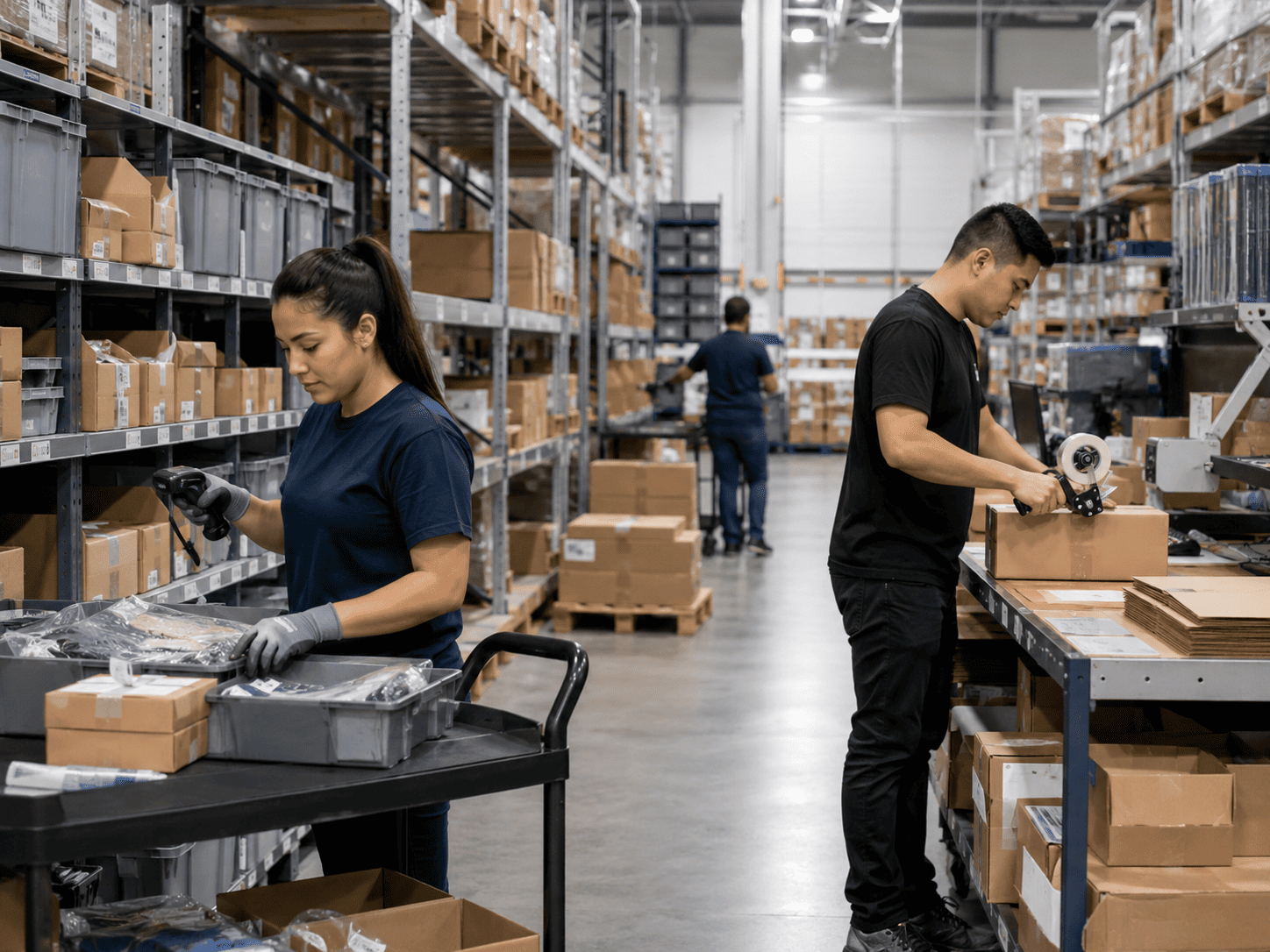
Warehouse distribution logistics are deeply interdependent. Without effective warehousing, distribution has nothing to work with. Without effective distribution, warehousing becomes a bottleneck. The best supply chains treat them as a unified system.
In practice, an optimized warehouse storage and distribution management system will:
- Use real-time inventory data to trigger replenishment orders before stockouts occur
- Route outbound shipments through the most cost-effective carrier based on delivery speed, destination, and package weight
- Process returns efficiently, restocking sellable goods, and flagging damaged items
- Scale capacity up or down based on seasonal demand without requiring additional facilities or staff
This is where a purpose-built warehouse management software platform becomes critical. Visibility across the entire fulfillment lifecycle, from inbound receiving to final delivery, is what separates reactive operations from proactive ones.
5 Benefits Of Outsourced Warehouse & Distribution
Managing warehousing and distribution in-house sounds appealing when you're small. But as order volumes grow, the complexity grows with them. More SKUs, more carriers, more customer expectations, more channels...
That's why a significant portion of growing e-commerce brands outsource warehousing and fulfillment to a 3PL. A 3PL handles the physical infrastructure and operational complexity so you can focus on product development, marketing, and customer relationships.
Key benefits of outsourcing distribution and warehousing to a 3PL include:
- Lower per-unit fulfillment costs through negotiated carrier rates and shared warehouse space
- Faster delivery times enabled by strategically located fulfillment centers closer to your customers
- Real-time inventory visibility through integrated software platforms
- Scalability to handle seasonal spikes without hiring, training, or leasing additional space
- Branded packaging and kitting capabilities that enhance the customer unboxing experience
Ready To Optimize Your Warehousing And Distribution?
If you're processing 20 or more orders a day, or working toward that goal, now is the right time to evaluate your warehousing and distribution strategy. The difference between a fulfillment process that holds your growth back and one that accelerates it often comes down to your logistics partner.
The Fulfillment Lab combines enterprise-level warehousing technology with the personal service of a boutique 3PL. There are no hidden fees, no getting lost in a ticketing system, and no compromising on speed. Just transparent pricing, real-time inventory data, and a team that treats your business like their own.
Get started with The Fulfillment Lab today!
Frequently Asked Questions About Logistics Warehousing And Distribution
What Is Warehousing And Distribution?
Warehousing is the storage and management of inventory at a dedicated facility. Distribution is the process of moving those goods to their final destination: a customer, a retailer, or a wholesale business. Together, they form the operational backbone of any supply chain.
Is Distribution The Same As A Warehouse?
No. A warehouse primarily stores goods for extended periods, while a distribution center focuses on rapidly processing and shipping orders. Distribution centers emphasize speed and throughput; traditional warehouses prioritize organized long-term storage and inventory accuracy.
What Are The 7 Types Of Warehouses?
The seven main warehouse types are: private warehouses, public warehouses, bonded warehouses, distribution centers, fulfillment centers, cold storage warehouses, and smart warehouses. Each serves a different operational need depending on industry, product type, and business model.
What Are The Four Types Of Distribution?
The four primary distribution types are direct-to-consumer (D2C), wholesale distribution, retail distribution, and omnichannel distribution. Choosing the right type depends on your sales channels, customer base, and order volume.
How Do Warehousing And Distribution Affect Customer Experience?
Directly and significantly. Fast, accurate distribution starts with well-organized warehousing. When inventory is tracked in real time and fulfillment is streamlined, customers receive orders on time with fewer errors, which drives repeat purchases and brand loyalty.
When Should I Outsource Warehousing And Distribution Services?
When managing fulfillment in-house starts slowing your growth, whether that's due to rising costs, shipping delays, or lack of scalability, it's time to consider a 3PL. Most brands benefit from outsourcing once they consistently hit 20 or more daily orders.